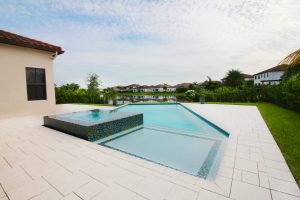

Few upgrades suit Fort Lauderdale homes better than a swimming pool. The water stays usable nearly every month of the year, and a well-built pool becomes the center of backyard life. Before any digging starts, though, it helps to understand how pool construction actually works in Broward County, including permits, contractor licensing, and Florida’s residential pool safety law. Essig Pools & Pavers has been designing and building award-winning custom pools and spas for South Florida homeowners since 1981, under Florida license CPC 1459804, and this guide walks you through the process from the first permit application to your first swim.
What are the Steps to Building a Pool in Broward County?
Building a pool in Broward County involves five major stages: securing a building permit through your local building department, hiring a state-licensed pool contractor, meeting Florida’s residential pool safety requirements, completing construction from excavation through interior finish, and passing final inspection before the pool can be filled and used.
Here is what each stage looks like in practice.
Step 1: Secure a Pool Permit
Every inground swimming pool in Florida requires a building permit before construction can begin. The Florida Building Code sets minimum standards for structural design, plumbing, electrical work, drainage, and safety barriers, and the permit itself is issued by the building department with jurisdiction over your property. In Fort Lauderdale, that is typically the city’s own building department; in unincorporated areas, Broward County issues the permit. Separate sub-permits cover the plumbing and electrical portions of the work, each with its own inspections.
Broward County’s Building Code Division lists specific submittal requirements for swimming pools, including:
- Two complete sets of building plans signed and sealed by a State of Florida Registered Architect or Engineer, with a registered land surveyor’s certificate included in each set.
- A current Broward County Uniform Building Permit Application for each discipline (structural, plumbing, mechanical, and electrical).
- A recorded Notice of Commencement for any job valued at $5,000 or more, filed with the county’s Records, Taxes and Treasury Division before the first inspection can be scheduled.
Plan review in Broward County can take up to 15 business days. Local details matter here too: pool construction plans in Broward County must account for water drainage, and some cities within the county, including Fort Lauderdale, require a fence affidavit separate from the standard pool permit. A contractor who works in this county regularly will know these requirements before the application goes in.
Step 2: Hire a Licensed Pool Contractor
Florida regulates pool contractors through the Construction Industry Licensing Board under the Department of Business and Professional Regulation (DBPR). The state issues four primary license types for pool and spa work. The one that matters most for a backyard build is the Certified Residential Pool Contractor license, which covers construction, repair, and servicing of residential pools and spas. Servicing-only licenses do not authorize new construction.
Earning a certified pool contractor license requires at least four years of verified experience in the trade, including a year in a supervisory role, plus a trade knowledge exam, a business and finance exam, and a financial stability review. You can verify any contractor’s license status through the DBPR’s online licensing portal before signing a contract. Hiring an unlicensed contractor puts your project at real risk: permits may be denied, inspections may fail, and you could carry significant liability if something goes wrong. Essig Pools & Pavers holds Florida license CPC 1459804, displayed on every page of our website.
Step 3: Plan for Florida’s Pool Safety Requirements
Under Section 515.27 of the Florida Statutes, part of the Residential Swimming Pool Safety Act, a new residential pool must include at least one approved safety feature to pass final inspection and receive a certificate of completion. The law accepts any one of the following:
- A barrier that isolates the pool from the home and meets the state’s pool barrier requirements.
- An approved safety pool cover.
- Exit alarms on all doors and windows with direct access to the pool, rated at a minimum of 85 dB A at 10 feet.
- Self-closing, self-latching devices on all doors with direct pool access, with the release mechanism placed no lower than 54 inches above the floor.
- A swimming pool alarm independently certified to ASTM Standard F2208 that sounds when someone enters the water.
Skipping this step carries legal consequences. Failure to equip a new pool with at least one of these features is a second-degree misdemeanor under Florida law. Your pool builder should design the safety feature into the project from the start rather than treating it as an afterthought.
Step 4: The Pool Construction Process
With permits in hand and a licensed contractor on the job, construction follows a well-established sequence. For most custom concrete pools, the build runs through nine stages:
- Design, engineering, and permitting: The pool’s shape, depth, and features are finalized, structural plans are engineered, and permits are secured from the municipality and HOA where applicable.
- Layout and excavation: The pool is staked out in the yard per the approved plans, then heavy equipment digs to the exact shape and depth while elevations are checked.
- Steel reinforcement: A framework of rebar is installed throughout the floor, walls, steps, benches, and spa. This skeleton is what gives a concrete pool its strength.
- Plumbing and electrical: Lines are run for skimmers, drains, returns, water features, and spa jets, conduit is placed for lighting and automation, and every plumbing line is pressure tested before anything gets covered.
- Shotcrete application: Concrete is pneumatically applied over the rebar framework and shaped by hand. Shotcrete arrives premixed, which is why many builders consider it the best option for the shell. Steps, benches, sun shelves, and spas take their final form, and soil is compacted back around the shell to support the surrounding deck.
- Tile, coping, and deck installation: Waterline tile goes in, coping is set around the perimeter, and the decking (pavers, travertine, or concrete) is installed.
- Interior finish: South Florida pools are typically finished with a pebble or aggregate surface, and the pool is filled with water immediately afterward to protect the finish while it cures.
- Equipment installation and start-up: Pumps, filters, and heaters are installed and activated, local authorities complete final inspections, and the builder walks you through how to operate everything.
- Ongoing service and maintenance: Regular cleaning, water balancing, and equipment checks keep the pool in good working condition for years.
For a closer look at what homeowners experience during each phase, read our guide to residential pool construction from start to finish.
What are Some Pool Maintenance Do’s and Don’ts After Construction?
Once your pool is up and running, a few habits protect the investment. These guidelines come from Florida pool maintenance best practices:
|
Area |
Do |
Don’t |
| Surface cleaning | Skim debris with a long-handled net every few days | Forget the strainer baskets, which need cleaning weekly |
| Water level | Top off the water regularly to keep the pump from drawing air | Assume summer water loss is evaporation alone; check for leaks |
| Filtration | Clean the filter when the pressure differential reaches about 10 to 15 PSI | Clean the filter too often, since a light layer of particles helps it trap debris |
| Circulation | Run the pump for at least a few hours once or twice daily | Run the pump around the clock, which stresses the motor |
| Draining | Turn the pump off first if the manufacturer recommends draining | Let the pool sit empty for long periods, since ground pressure can lift the shell |
| Chemicals | Keep pH between 7.2 and 7.6 and chlorine around 1 to 3 ppm | Shock the pool in midday heat; evening treatment works better against algae |
| Brushing and vacuuming | Vacuum weekly and match your brush to the surface | Use a stiff bristle brush on anything other than a plaster-lined pool |
Inground Pools and Spas by Essig Pools & Pavers
Whether you want something simple and budget-friendly or an exotic backyard resort, Essig Pools & Pavers has the talent to transform your backyard into your dream pool escape. Our custom pool and spa work spans classic and straight-line designs, freeform and lagoon shapes, infinity and wet-edge pools, Roman, Grecian, and geometric layouts, custom hot tubs and in-ground spas, and more. As our own team puts it: “If you can dream it, we can build it.”
Every Essig pool is built as The Smart Pool™, a shotcrete shell constructed 15% stronger than Florida’s building code requires and backed by a lifetime structural warranty. That construction philosophy is a big part of why more than 5,000 South Florida homeowners have trusted us with their backyards since 1981.
The industry has noticed too. Our recognitions and awards include more than 200 industry honors: the Aqua 100 Hall of Fame for being named a Top 100 Builder five consecutive years, multiple Top 50 Builder distinctions from Pool & Spa News Magazine, the Industry Choice Award for Business Excellence five times, and the APSP International Awards of Excellence, which Essig Pools & Pavers has won twice. The next time a pool builder tells you they’re award-winning, ask to see their list. We’ll show you ours.
Our associations and certifications back that record up. Essig Pools & Pavers is a member of the Aquatech Society, an invitation-only organization that has approved less than 1% of pool builders worldwide, along with United Aqua Group and the Association of Pool & Spa Professionals.
Budget should never keep you from getting started. Our financing options include no money down, terms up to 20 years, and up to 120% financing, with pool loans available at very competitive rates and little or no equity required. A simple online application through HFS Financial can get you moving right away, and we’ve helped hundreds of people that other builders turned down.
Ready to Start Your Fort Lauderdale Pool Project?
From the Broward County permit desk to the final inspection, every stage of pool construction goes smoother with a builder who has done it thousands of times before. Essig Pools & Pavers handles the design, engineering, permitting, and construction so you can focus on the fun part: planning your first pool day. Request your free quote today and tell us about the backyard you have in mind.
Frequently Asked Questions
How long does it take to build a pool in Broward County?
Timelines vary with the size and complexity of the project, the permitting workload in your municipality, and weather conditions. Plan review alone in Broward County can take up to 15 business days, and a custom pool build in South Florida can take several months from permit approval to completion. An experienced, organized builder keeps the project moving and minimizes delays.
Can I pull my own pool permit in Broward County?
Yes. Homeowners applying for their own permit in Broward County must complete an Owner/Builder Affidavit in the presence of permitting staff. Most homeowners let their licensed contractor handle permitting instead.
What is a Notice of Commencement?
It is a legal document that officially marks the start of a construction project. In Broward County, any job valued at $5,000 or more requires one, filed with the Records, Taxes and Treasury Division, and a certified copy must be submitted before the first inspection can be scheduled.
When is the best time of year to start a pool project in Florida?
The drier months from November through April generally offer smoother excavation, faster curing for concrete and deck work, and fewer weather-related inspection delays. Florida’s rainy season runs roughly May through October, and fall or winter starts often mean better contractor availability.
How do I verify a pool contractor’s license in Florida?
Search the contractor’s name or license number through the DBPR’s online licensing portal. An active certified license confirms the contractor has passed the state’s trade and business exams and met its experience requirements.