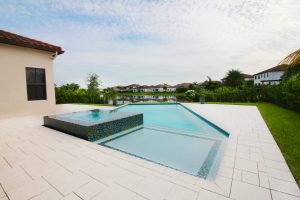

Two homeowners call about the same tired-looking pool and describe it two different ways. One says her pool needs renovating. The other says that his needs remodeling. They mean roughly the same thing, but only one of them is describing the project that will actually get quoted, permitted, and built.
The distinction matters because it changes the scope, the timeline, the engineering, and the price.
Essig Pools & Pavers has been building and rebuilding South Florida pools since 1981. In that time we have delighted more than 5,000 homeowners with new pools, and we handle renovations and full remodels for homeowners across Miami-Dade County, Broward County, and Palm Beach County under one Florida license, CPC 1459804. Because we do both, the conversation starts with what your pool actually needs.
Pool Renovation vs. Pool Remodeling: The Short Answer
A pool renovation restores an existing pool without changing its shape or footprint: new interior finish, tile, coping, and equipment. A pool remodel changes the design itself, adding features like a spa, tanning ledge, or vanishing edge, or altering the pool’s size, depth, or geometry. Renovation restores. Remodeling redesigns.
Most contractors and most homeowners use the two words interchangeably, and our own Luxury Outdoor Remodel page reflects how blurred the line has become in practice. A pool renovation can be a simple facelift, or it can be a whole lot more. The useful question is not which label to use. It is how far into the structure the work goes, because that determines everything downstream.
| Pool Renovation | Pool Remodel | |
| What changes | Surfaces, finishes, and equipment | Design, layout, features, and geometry |
| Shape and footprint | Stays the same | Often changes |
| Typical scope | Resurfacing, waterline tile, coping, deck refinishing, pump and heater upgrades, LED lighting | New built-in spa, tanning ledge, beach entry, vanishing edge, water features, depth or shape changes |
| Engineering drawings | Rarely needed | Usually required when structure is altered |
| Permit in Miami-Dade | Cosmetic-only resurfacing is generally exempt | Required for structural, plumbing, electrical, drain, or dimension changes |
| National cost range | $6,000 to $15,000 for resurfacing | $1,600 to $30,000 for a remodel; reshaping a pool runs $50,000 to $100,000 |
| Right when | The shell is sound and the design still works | The design no longer fits how you use the backyard |
Cost figures above come from national data published by Angi and HomeGuide. South Florida pricing depends on pool size, finish material, and site access, and we break those variables down in our guide to how much a pool renovation costs.
When a Pool Renovation Is the Right Call
Choose a renovation when the pool’s bones are still good and the problem is age, wear, or dated materials. The shell stays exactly where it is. Everything you touch and see gets replaced.
Signs your pool needs a renovation rather than a remodel:
- The interior finish is rough underfoot, stained, or chalky.
- Waterline tile is chipped, faded, or falling off.
- Coping is cracked or has separated from the deck.
- The deck surface is worn, slippery, or discolored.
- Equipment is loud, expensive to run, or predates variable-speed pumps.
- Lighting is still halogen rather than LED.
Our renovation work covers the interior surface, from exposed aggregate to a polished finish to an all-tile pool, in any color you want. It also covers deck, coping, and tile updates, along with new materials such as pavers, natural stone, mosaic designs, and waterline tile.
There is a second reason homeowners in Dade and Broward renovate: operating cost. Automatic control systems, heat pumps, chlorine generators, and variable speed pumps all lower what the pool costs to run month to month, and they can be installed without touching the shell at all.
When a Pool Remodel Makes More Sense
Choose a remodel when the pool is structurally fine but the design has stopped working for your family. A freeform that made sense in 1994 for a household with two small children is a different pool from the one that suits teenagers, or entertaining, or a backyard that has since been rebuilt around it.
Remodeling territory includes:
- New designs, such as adding a built-in spa, a vanishing edge or perimeter overflow feature, beach entries, tanning ledges, in-water tables, and custom chairs and bar.
- New water features, such as sheer descents, scuppers, bubblers, water spouts, natural rock waterfalls, rain walls, and grottos.
- Changes to size, depth, or shape, which is the most involved category and the one that pulls engineering and permitting into the project.
- LED lighting and laminars, which change how the pool reads at night.
No matter how old your pool is, or what the design, we can turn it into the stunning new masterpiece you’ve dreamed about. A custom in-ground spa can be built in conjunction with a swimming pool or completely stand alone, and the design options for spas are as varied as the options for a custom pool.
One practical note on sequencing. If the interior finish is at the end of its life and you have been considering a spa or a tanning ledge for a few years, doing both at once is cheaper than doing them separately, because the pool only gets drained, prepped, and refilled once.
Permits and Engineering: The Part Most Homeowners Miss
This is where renovation and remodeling genuinely diverge, and it is the part almost no comparison article covers.
In many city municipalities, cosmetic resurfacing that applies new plaster, quartz, or pebble over an existing shell, with no plumbing, main drain, or structural modification, is exempt from permit requirements. As soon as the work involves structural repair, equipment relocation, electrical changes, or any change to the pool’s dimensions, a building permit is required. Structural work generally means submitting drawings stamped by a professional engineer, along with a site plan and a signed safety barrier affidavit.
Miami Dade and Broward County run their own inspection sequence, and about 31 incorporated municipalities in each county, including Miami, Miami Beach, Coral Gables, Fort Lauderdale, Hollywood, Pompano Beach, Coral Springs, Miramar, and many others retain their own building departments. Shell work is inspected for thickness and coverage over reinforcing steel. Barrier compliance is verified against Florida Statute 515, the Residential Swimming Pool Safety Act, which requires an approved drowning prevention feature before an open permit can be closed.
Three things follow from this that affect who you hire:
- The contractor pulls the permit, not you: Florida requires a licensed Certified Pool/Spa Contractor to file it on your behalf. The CPC license issued through the Florida Department of Business and Professional Regulation authorizes the holder to construct, service, repair, maintain, renovate, or remodel a pool.
- Unpermitted work is not a paperwork problem: Under Florida Statutes 553.79 and the Florida Building Code, work performed without a required permit is an unlawful act, and county enforcement can include stop-work orders and mandatory demolition of completed work.
- A quote that skips the permit line is a quote for a different project: If a remodel changes depth or geometry and the estimate contains no engineering or permit cost, either the scope has been quietly reduced or the permit is not being pulled.
We handle permitting and inspections as part of the project in every jurisdiction we serve all over Dade and Broward counties.
Choosing a Pool Renovation Company in Dade and Broward Counties
Renovation and remodeling work is harder than new construction in one specific way: you are working with a structure someone else built, blending new finishes against old ones, and routing plumbing and electrical through spaces that are already full. There is very little margin for correction once a pool is resurfaced.
Here is what to check before you sign anything, and what should give you pause.
Verify before signing:
- A current Florida Certified Pool/Spa Contractor license, checked by number through the Department of Business and Professional Regulation.
- That the company, not a subcontractor you never meet, is pulling the permit.
- Written scope that names the finish material, the tile, the coping, and the equipment models.
- Who is responsible for barrier compliance at final inspection.
- References on renovation and remodel projects of similar age and scope.
Red flags:
- A price quoted over the phone without a site visit.
- Pressure to start before permits are issued.
- A remodel quote with no engineering line item where depth or shape is changing.
- Cash-only or large upfront deposits.
- Vague language about who fixes surface problems that appear after the pool is refilled.
Essig Pools & Pavers has been doing this in South Florida since 1981. Our work has earned more than 200 industry awards, including induction into the Aqua 100 Hall of Fame, recognition as a Top 50 Builder, the Industry Choice Award five times, and the APSP International Award twice. We are members of the Aquatech Society, a distinction held by less than 1% of builders worldwide. You can see the full list on our recognitions and awards page.
The pools we build are built with The Smart Pool™ shotcrete shell, engineered 15% above Florida code and backed by a lifetime structural warranty. Our team can look at a 30-year-old shell and tell you whether it will hold a new finish or whether structural repair needs to come first. If you want the detail on why we use shotcrete rather than gunite, we wrote about shotcrete vs. gunite pools for Florida homeowners.
You can also walk the materials in person, our showroom in Miramar has many tile and decking samples and you are welcome to come by and visit us to see who you will be working with.
Renovation, Remodel, or Both
If your pool’s shell is sound and you want it to look and run like new, you want a renovation. If the design itself no longer fits your backyard, you want a remodel. If the finish is worn out and you have been dreaming about a spa, you want both, done in one project, on one permit.
Essig Pools & Pavers does all three for homeowners throughout Miami-Dade and Broward Counties, with financing available at no money down, terms up to 20 years, and up to 120% financing.
Request Your Free Quote and we will look at your pool, tell you which project it actually needs, and price it in writing.
Frequently Asked Questions
1. How long after resurfacing can we swim?
Plan on about a week. A new plaster or aggregate finish needs careful chemical management while it cures, which usually means brushing the surface twice a day and running the pump continuously before the pool is ready to use. Refilling alone takes 12 to 48 hours depending on pool volume and water pressure.
2. How long should a new interior finish last?
It depends entirely on the material. Plaster typically lasts around ten years. Aggregate and pebble finishes commonly run 15 to 20 years or more. Tile lasts the longest of the three and has the practical advantage that individual tiles can be replaced without redoing the whole surface.
3. Will you renovate a pool another company built?
Yes. Most renovation and remodeling work we do is on pools built by someone else, some of them decades old. The evaluation starts with the condition of the existing shell, since that determines whether a new finish will bond properly or whether structural repair needs to happen first.
4. Does a pool remodel add value to the home?
An updated, well-maintained pool is generally treated as a positive by the market, with national estimates putting the effect on home value in the range of 5% to 7%. The stronger argument is usually use rather than resale: a pool that fits how your family actually spends time outside gets used, and one that does not gets covered.
5. Do we have to redo the deck at the same time as the pool?
Not necessarily, but coping sits at the boundary between the two, so replacing coping usually means disturbing the first section of deck. Deck work adds roughly a week to the schedule. If your deck has another five good years in it, it can wait. If it is already cracked or worn, doing it together avoids paying twice for the same demolition and cleanup.
6. Do you serve my city?
We serve homeowners throughout Miami-Dade County, Broward County, and Palm Beach County, from Aventura and Coral Gables to Fort Lauderdale, Plantation, Pembroke Pines, and Parkland. The full list is on our service areas page.